
EN
QR-15 Patrol Unit: Mobile Anti-UAV System for Border Security
QR-15 Patrol Unit: Mobile Anti-UAV System for Border Security
Dec 01, 2025
QR-15 Patrol Unit: a Moving Shield Against Drone Threats at the Border
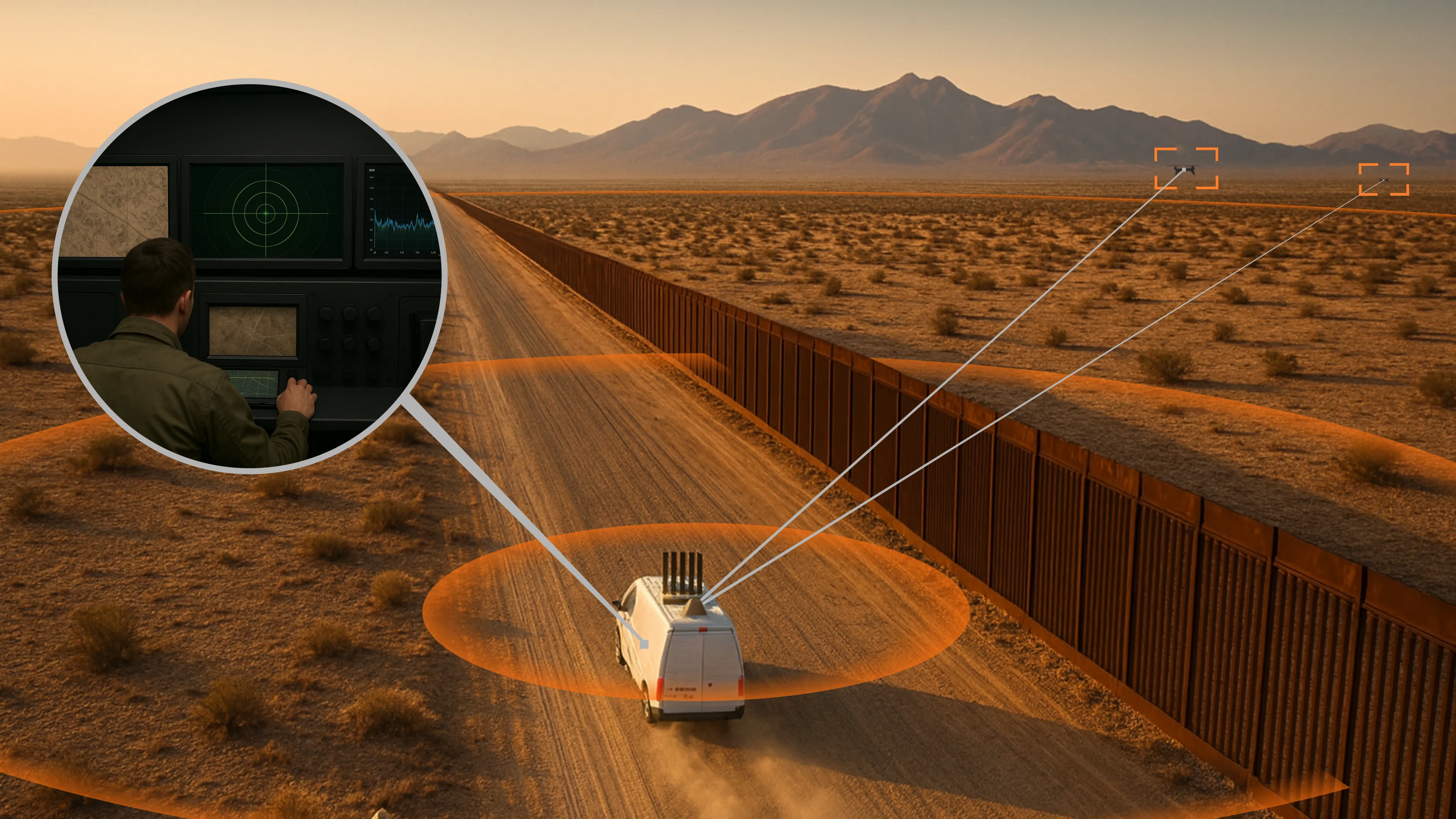
A dusty road along the fence, a patrol van raising a light trail of sand, and a quiet desert sky. Nothing looks unusual from the outside. Inside the vehicle, though, an operator is watching a radar screen. Two small echoes appear on the edge of the display. Drones. The system reacts in seconds, and the threat never reaches the border.
This is exactly the scenario the QR-15 Patrol Unit was built for: a mobile anti-UAV system that turns a standard utility van into a moving detection and jamming platform. Its mission is simple and very concrete – detect hostile drones early, neutralize them quickly, and keep border operations running.
QR-15 Patrol Unit: omnidirectional drone detection (5 km) and jamming (2 km) integrated into a single mobile system.
1. How drones are reshaping border security
Border protection used to be mostly horizontal. Patrols, vehicles, fences and cameras focused on the ground. During the last decade, a new dimension has quietly appeared above all this – the low-altitude airspace where small drones operate.
Today, a simple commercial drone can cross a border in a few minutes, carrying a small payload or a camera. When several drones fly at the same time, they can quickly overwhelm traditional systems that were built to follow people and vehicles, not dozens of moving targets in the sky.
On real borders, security teams are already dealing with situations such as:
- Cross-border drops of drugs, weapons or other contraband at night.
- Use of multirotor drones to scout patrol patterns and blind spots.
- Small fixed-wing UAVs flying higher and further to collect intelligence.
- Swarm tactics, where several drones appear together to stress detection chains.
Fixed cameras, radars and towers remain essential, but they share a limitation: once installed, they stay where they are. If a smuggling route moves ten kilometres up the fence, the infrastructure rarely follows at the same speed.
2. What the QR-15 Patrol Unit brings in practice
The QR-15 Patrol Unit is not a tower, not a container and not a static installation. It is a complete mobile anti-UAV solution integrated into a utility van. From the outside, the vehicle remains discreet; from the inside, it operates as a compact command post focused on the airspace.
2.1 A full anti-UAV system inside one vehicle
Instead of splitting detection, tracking and jamming across several sites, the QR-15 gathers everything in a single platform:
- Omnidirectional drone detection with a bubble of up to 5 km around the vehicle.
- Effective jamming and neutralisation within a radius of up to 2 km.
- An integrated operator console with radar-style views and map-based situational awareness.
- Self-contained power and communications sized for long patrols on dirt or paved roads.
Everything is installed on board. There is no need for separate shelters, trailers or heavy foundations. If the van can reach a road, the drone detection system can operate.
2.2 Performance that matters for border surveillance
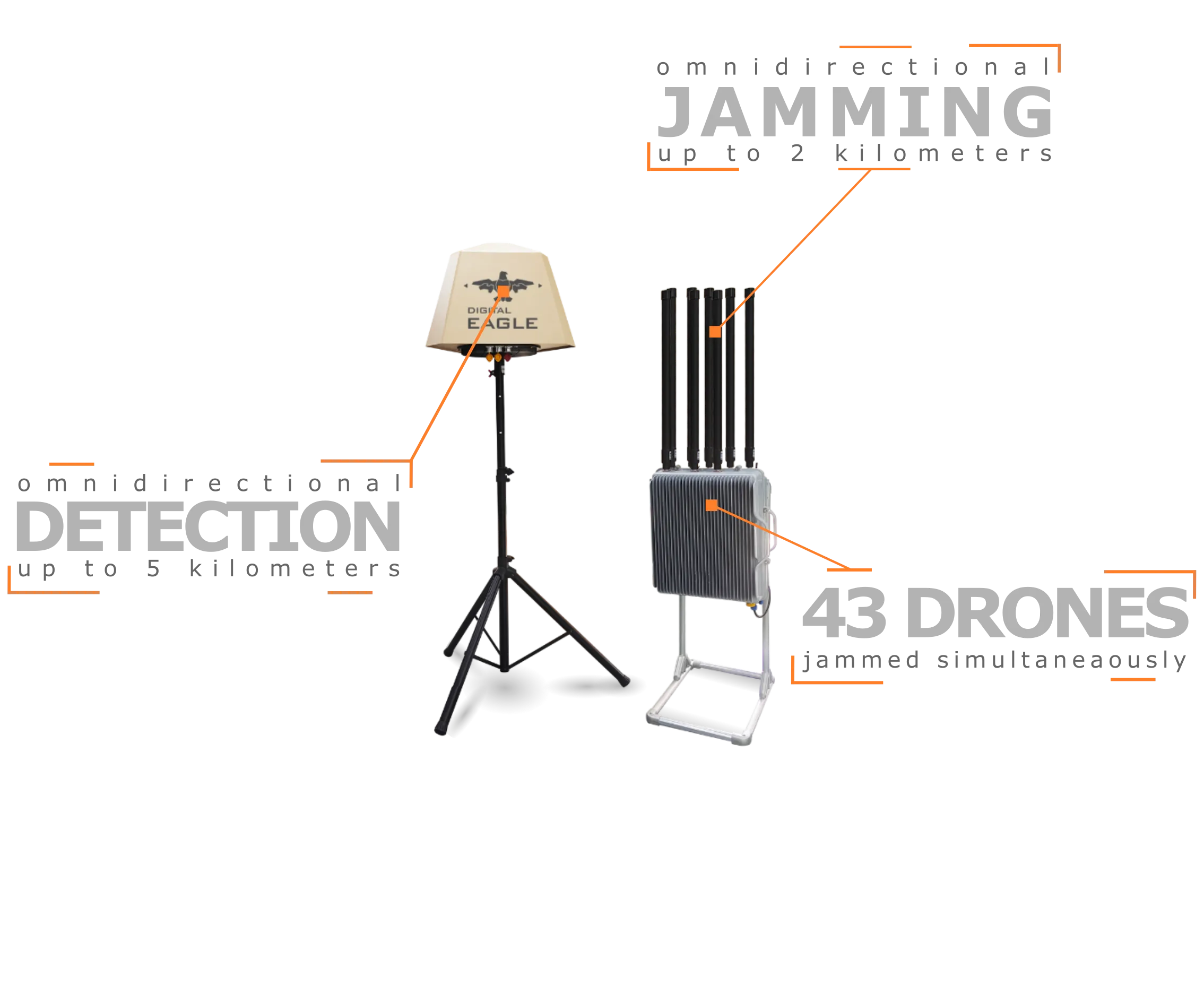
In real operations, a few numbers make a clear difference:
- Detection range: up to 5 km with full 360° coverage around the QR-15 van.
- Jamming range: up to 2 km to quickly disrupt control and telemetry links.
- Reaction time: under 3 seconds between detection and jamming command once the operator confirms the threat.
- Continuous scanning: the system keeps monitoring the sky while the vehicle is in motion or parked.
For border agencies, this means early warning, extra time to decide what to do, and the ability to neutralise drones before they reach the fence, a patrol unit or a critical site.
5 km detection bubble
Omnidirectional detection ensures that drones approaching from any direction are identified early and tracked as they move around the patrol route.
2 km neutralisation dome
Within this radius, the QR-15 can disrupt the links of hostile UAVs, forcing them to land, hover or return to their starting point.
< 3 s reaction time
A streamlined workflow from detection to jamming allows operators to respond fast, which is crucial when dealing with high-speed flights or swarm attacks.
3. How the mobile anti-UAV system works on patrol
3.1 Life inside the QR-15 van
Picture a typical night shift. The QR-15 drives slowly along a dirt road that mirrors the border. Inside, the light is low to preserve night vision. Two operators sit in front of the console – one focuses on the aerial picture, the other on the map and radio communications.
Suddenly, a symbol appears on the edge of the radar view. A potential drone. The system estimates distance and angle, then raises a clear visual and audio alert. The operator checks the track, looks at its behaviour, and compares it with intelligence about current threats.
At this stage, the drone is still far enough; there is time to verify. If the rules of engagement are met, the operator authorises jamming with a single action. Within seconds, the QR-15 neutralises the link. The drone stops progressing towards the border and the risk is removed without interrupting ground operations.
3.2 Omnidirectional detection – no blind spots along the route
The detection system of the QR-15 is designed for omnidirectional coverage. It constantly scans the full 360° around the vehicle to avoid blind sectors, even when the road turns or the terrain changes.
Because the bubble moves with the van, you do not protect a fixed point on the map but a moving portion of the border. This makes it harder for smugglers to predict where the airspace is monitored and forces them to take more risk if they want to bypass patrols.
3.3 Jamming adapted to regulations and mission profiles
Jamming is a powerful measure and must respect local regulations. The QR-15 Patrol Unit is configurable so that each country can adapt power, frequency ranges and patterns to its legal framework and operating procedures.
In practice, this allows agencies to:
- Limit interference with friendly communications and navigation services.
- Focus jamming energy on the sectors where the threat is actually coming from.
- Fine-tune the behaviour of the anti-UAV system for different classes of drones.
3.4 Why reaction time below three seconds matters
A multirotor launched from just one kilometer away can reach the border fence in less than a minute. If the system takes too long to detect and react, there is simply no room left for human decisions.
The QR-15 was designed with this reality in mind. Once a hostile drone is confirmed, the sequence from operator validation to jamming is extremely short – under three seconds. This responsiveness is especially important for swarm scenarios, where several UAVs appear simultaneously and demand quick, prioritised actions.
4. Typical use cases for border agencies
4.1 Daily patrols with a moving protection bubble
The most straightforward way to use the QR-15 Patrol Unit is to include it in regular patrol routes. Instead of sending a standard vehicle along the fence, teams deploy the van equipped with the mobile drone detection system.
With this approach:
- Every kilometre patrolled on the ground is also scanned in the air.
- Patrol routes remain familiar to crews; only their capabilities change.
- Border sections can be prioritised or deprioritised simply by adjusting patrol frequency.
4.2 Reinforcing fixed installations and closing gaps
Most borders already rely on fixed radars, cameras and ground sensors. However, terrain, vegetation and new infrastructure always create small gaps that are hard to remove entirely.
The QR-15 can act as a flexible reinforcement tool:
- Cover valleys, river crossings or urban zones where fixed sensors are less efficient.
- Bring additional jamming capacity when intelligence suggests an increased drone risk.
- Temporarily replace fixed systems during maintenance or upgrades.
4.3 Temporary events, construction sites and crisis areas
Some situations are short-lived but sensitive: a construction site along the fence, a large joint operation, a VIP visit close to the border, or a sudden crisis linked to migration flows. In these cases, building a permanent installation is neither practical nor cost-effective.
A mobile anti-UAV system like the QR-15 can simply drive to the location, stay as long as needed, and then leave without altering the environment.
5. Integration with your existing surveillance architecture
5.1 A mobile node in your C2 system
Border security rarely relies on a single sensor. Command-and-control centres bring together radars, cameras, UAV feeds and field reports in a unified picture. The QR-15 Patrol Unit can connect to this architecture to share what it detects.
Depending on project requirements, the system can:
- Send real-time tracks and alerts to central C2 software.
- Receive mission updates and patrol routes from coordinators.
- Log detection and neutralisation events for after-action reviews or legal documentation.
5.2 Working alongside VTOL and fixed-wing UAVs
Many agencies already deploy VTOL drones and fixed-wing UAVs for border surveillance. These aircraft extend visibility far beyond the fence but also become higher-value targets.
The QR-15 helps protect these assets by:
- Securing take-off and landing zones against hostile drones.
- Protecting temporary bases, refuelling points and docking stations.
- Extending the anti-UAV protection bubble around critical infrastructure monitored by UAVs.
6. Key benefits of a mobile drone detection system
6.1 Flexibility and adaptability
Threats move. Smugglers test new routes. Weather and seasons shift activity from one sector to another. A fixed system struggles to follow this pace. The QR-15, on the other hand, can be reassigned from one segment of the border to another in a single shift.
6.2 Cost-effectiveness on long borders
Building a dense line of fixed anti-drone towers along hundreds of kilometres of border is rarely realistic. A mixed model often makes more sense: key sites are protected by permanent systems, while several QR-15 units move to where the risk is highest on a given week or month.
6.3 Resilience and redundancy
Any complex surveillance architecture can experience outages or maintenance periods. When this happens, a QR-15 Patrol Unit can temporarily take over drone detection and jamming for that sector, keeping the overall system resilient.
6.4 Human-centred design for operators
Finally, the QR-15 is designed around the crew. Interfaces use clear symbols, simple colour codes and straightforward alerts so that operators can stay focused even after long hours. The goal is not only to deliver technology, but to give teams a tool they can trust and master quickly.
7. How to decide if QR-15 fits your mission
Before adopting a mobile anti-UAV solution, most agencies ask themselves the same questions. You can use them as a checklist:
- Typical threat profile: Are you mainly facing small multirotors, long-range fixed-wing UAVs, or a mix of both?
- Terrain and infrastructure: Do mountains, rivers or urban areas limit the efficiency of existing towers and radars?
- Rules of engagement: Who is allowed to trigger jamming, and what documentation is required afterwards?
- Integration needs: Should the QR-15 work as a stand-alone patrol asset, or be fully connected to a central C2 system?
- Budget and timelines: Are you looking for a fast-to-deploy capability, or a long-term architecture redesign?
Once these points are clear, it becomes easier to decide how many QR-15 units are required, which sectors they should cover first, and how they complement your fixed systems and UAV fleet.
8. Short FAQ for decision makers
Is the QR-15 Patrol Unit only for national borders?
No. The same approach works for large industrial corridors, pipelines, coastal areas or critical infrastructure sites that need a mobile drone detection system instead of a permanent installation.
How many people are needed to operate the system?
A typical crew is one driver and one operator. For complex missions, a third person can manage communications and coordination with other units.
How does the system handle jamming regulations?
Jamming is always aligned with national regulations. The QR-15 offers configurable parameters so that authorised frequencies, power levels and behaviours match the legal framework in each country.
Can the QR-15 be installed on different vehicles?
The standard configuration is a utility van, but the concept can be adapted to other platforms, including 4×4 vehicles for rougher terrain or specific fleet requirements.
9. Next steps and how to go further
Drone threats at the border will keep evolving. They will become more coordinated, more automated and harder to predict. To stay ahead, border forces need tools that are both technically solid and operationally flexible.
The QR-15 Patrol Unit offers a practical answer: a mobile anti-UAV system that combines 5 km omnidirectional detection, 2 km jamming range and sub-three-second reaction time, all integrated in a single patrol vehicle.
If you are currently assessing options to strengthen your border surveillance or to deploy a cost-effective drone detection system, the next step is simple: discuss your map, your terrain and your existing assets with our team. From there, we can design together how a mobile solution like the QR-15 can best support your mission.
We can provide detailed technical specifications, example deployment plans and live demonstrations adapted to your environment.
Talk to our team about QR-15 deployment options
Recent Posts

October 26, 2016
The Most Successful Engineering Contractor


Nov 14, 2025
Firefighting Drone Extinguisher for SK-XF07

Jun 27, 2025
UAV Training AcademiesContact US
Product Information
Quantity
Unit
Piece
Support order samples, customization, wholesale direct, and complete payment. If the product you look for does not have corresponding customized content, pls fill out the form below to contact us, and we will reply ASAP.